Biography
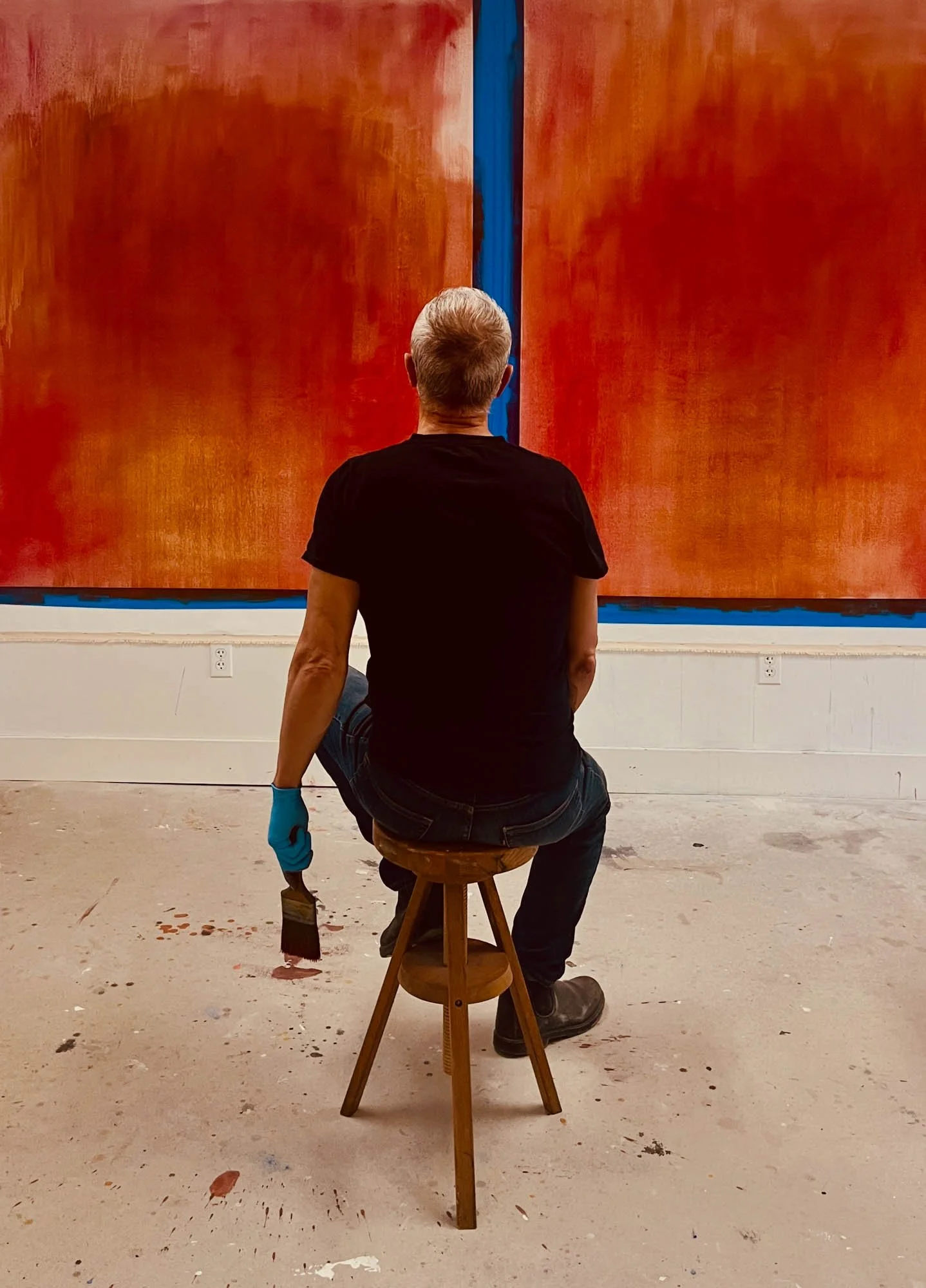
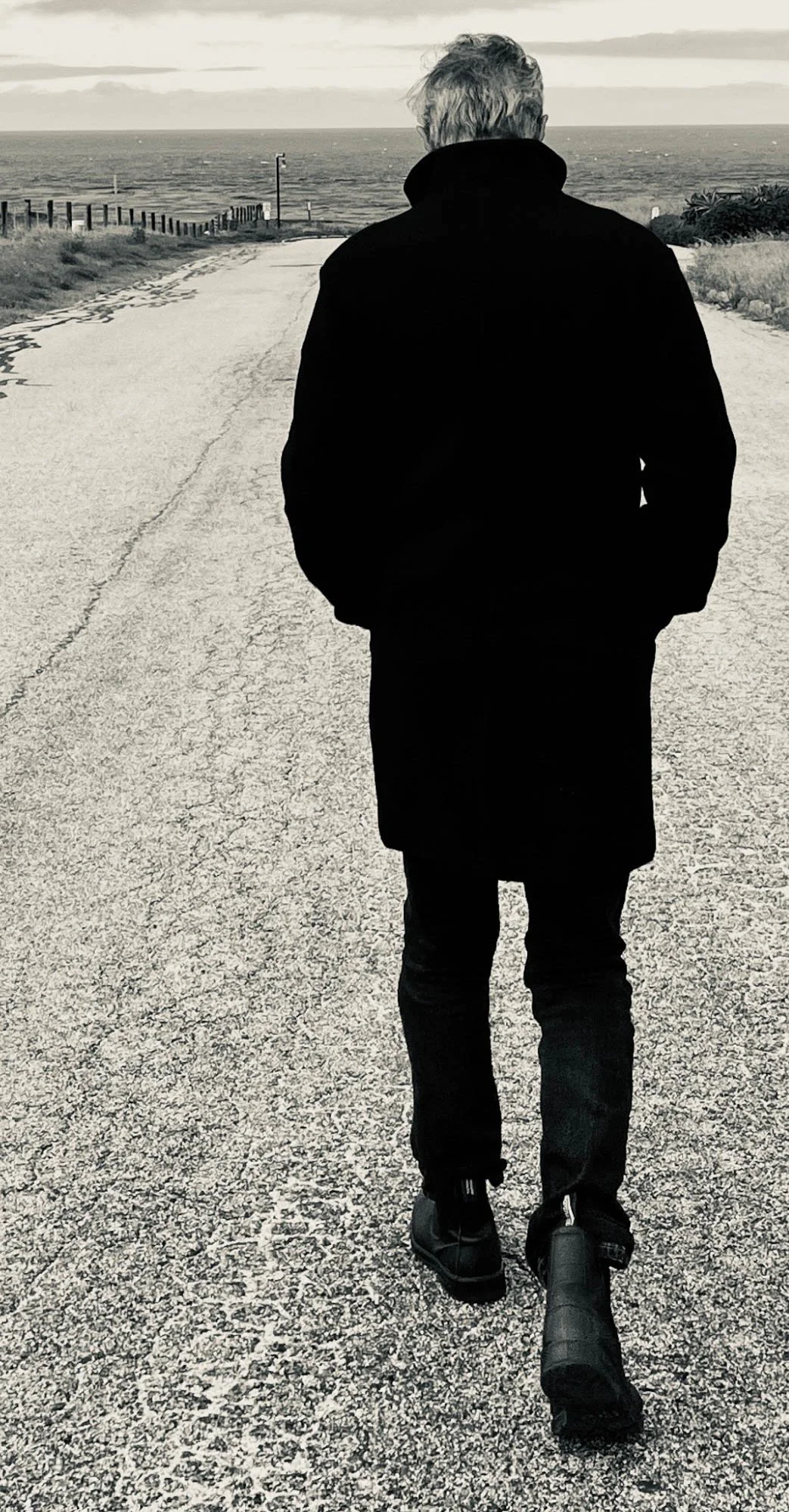
Mark Russell Jones’ work occupies a resonant space between abstraction and representation, where landscape becomes both subject and metaphysical inquiry. Born on California’s Central Coast and raised in the agricultural region of Santa Maria, Jones developed an early and enduring sensitivity to the natural world. The vast horizons, shifting sand dunes, and expansive coastline of his youth—experienced intimately through life on his father’s ranch—continue to inform the atmospheric and emotional depth of his work.
Jones received his BFA in Painting with distinction from the California College of the Arts in Oakland, where he pursued a rigorous, multidisciplinary course of study that included art history, photography, drawing, design, and printmaking. During this time, he was recognized with the Vivian Isabel Bolton Scholar Award and the Peter Chapman Scholar Award for Painting, distinctions that underscore both his technical command and conceptual promise.
At the core of Jones’s practice is a synthesis of observation and transformation. Working across photography and drawing, he approaches the landscape with a sensibility akin to that of a documentary filmmaker—traveling extensively and recording his encounters with diverse terrains across Europe, the Middle East, Russia, China, Japan, New Zealand, and the Caribbean. Having lived and worked in cities including Milan, Paris, Madrid, Auckland, Tokyo, and Osaka, Jones gathers a visual archive of black-and-white photographs and studies that capture the fleeting qualities of light, atmosphere, and geography. These source materials are later distilled in the studio through a process of editing and reimagining, culminating in large-scale oil paintings that transcend literal depiction.
Hovering between the tangible and the immaterial, Jones’s paintings investigate spatial perception and the elemental forces of air, fire, water, and earth. His work aligns with a lineage of painters such as J.M.W. Turner, Mark Rothko, and Gerhard Richter, yet remains distinctly his own in its quiet intensity and meditative restraint. These luminous compositions evoke landscapes not only as physical places but as vessels of memory, identity, and interior experience.
In Jones’s work, the landscape becomes a threshold—an arena where the visible and invisible converge. His paintings suggest environments that are at once grounded and otherworldly, offering viewers an immersive encounter with stillness, presence, and emotional resonance. There is a contemplative quality to these works that resists spectacle, instead inviting a deeper engagement with the elemental and the enduring. Echoing the poetic notion of the Elysian Fields, his compositions inhabit a suspended realm where time, memory, and becoming coexist.
Since 1996, Jones has exhibited widely across the United States, with shows in New York, Chicago, Los Angeles, San Francisco, Santa Barbara, Palm Springs, and Texas. His work has been reviewed in publications including California Home+Design, the Santa Barbara News- Press, and the Chautauquan Daily, where he was also the recipient of the VACI Partners Award. His paintings are held in private collections throughout the United States, as well as in Europe, Japan, Australia, and New Zealand.
Over the past two decades, Jones has cultivated a practice devoted to exploring the intersections of time, space, and perception. His large-scale, ethereal works function as both landscapes and portals—immersive fields of color and light that engage the viewer on a visceral and introspective level. Minimal yet expansive, his paintings are meditative, sensual, and boundless, offering a contemporary reflection on the enduring power of landscape in the history of art. Jones splits his time, living and working on both the coast of California and the mid coast of Maine.
ARTIST STATEMENT
My work explores the space between abstraction and representation through a process of layering, editing, and reduction. Beginning with subtle markings that map the terrain, each painting evolves through acts of removal and discovery, guided by intuition and restraint. The resulting images evoke a sense of memory and atmosphere—moments suspended between time and place. Rather than fixed depictions, the paintings remain open, inviting an emotional and contemplative response.